
We have run into a number of people who sailed to Hawaii and decided to stay. It is easy to understand why. Last August, we decided to stay for a couple of months, and that turned into staying for the winter. We have sailed to six of the eight islands of Hawaii, and had very rich experience, but just scratched the surface. We are tempted to stay longer. The question lately has been, why leave? The answer to that question is that we live in the San Francisco Bay area, and we miss our family and friends there. Plus, the return trip is the last big unknown of this adventure. I have never done it, so I am motivated to get this experience under my belt. It is not a race, so the dynamics are totally different. We can relax and sail in cruising mode, slowly and deliberately.
We waited to the May to return because this is the rule of thumb among sailors for returning to California. The primary source of this “rule” is Jimmy Cornell, who wrote the bible for cruisers, “1,000 Cruising Routes of the World.” The historical pattern is that a large high pressure pattern settles into the eastern Pacific region, in May, which is then sailed around or through, depending upon where is settles.
For a boat making a trip from Hawaii to SF, this usually means sailing due north from Hawaii to about the 30th parallel, and then starting to work to the northeast, while avoiding the middle of the Pacific High, where there is no wind. By the 38th parallel, it is usually possible to head due east. The last 500 miles to California are the most challenging, as it gets cold again, and the pressure builds into strong winds and rough seas. We will see what happens this year.
We are planning to leave Hawaii later this week, around May 25th, from Lahina. We are going there to pick up Jimmy Laing, our third crew member. We know Jimmy from Alameda, where he is a woodworker and cabinet-maker. He helped Avion pass the Pac Cup safety inspection by making an emergency tiller. While working on that project, he told us that he had lived in Maui in his twenties, and had offered to help with the return delivery. When my brother said he could not make the three week commitment, we called Jimmy, and he immediately said yes.
We have been focused on preparing Avion since April. The boat is in good shape, overall, as we have fixed any issues as they came up. But several critical path projects did emerge in PAril that had to be addressed. I found two cracks in the rudder. We were very fortunate to find Jim Maynard of PDF-Hawaii. His crew dropped the rudder, repaired it, and installed it again within 3 weeks. Avion was well designed, so the rudder could be removed while still in the water, without having to do a haul-out. Jim also invited us to sail on his boat, Wasabi on a Friday Night Beer Can Race, which we won. (See previous posting.)


We have completed a number of other less significant repair projects, such as a replacing a ball valve attached to a through-hull that feeds salt water to the head. This was a high risk project that I was able to complete over 3 days. At the start of this project, I knew the the head had failed, but it was not clear why. I took apart all the plumbing for the outflow, and did not find any blockage. I then discovered that the intake to the head was blocked, and finally found the cause was a closed ball valve; the handle had broken off in the closed position. After the new ball valve was in place, the head still would not pump properly, due to a small vacuum leak in the pump handle, that I had taken apart. I had to buy and install a new head. Oh well, this is mission critical for a 2,000 mile trip, so I am glad the head failed while at the dock.

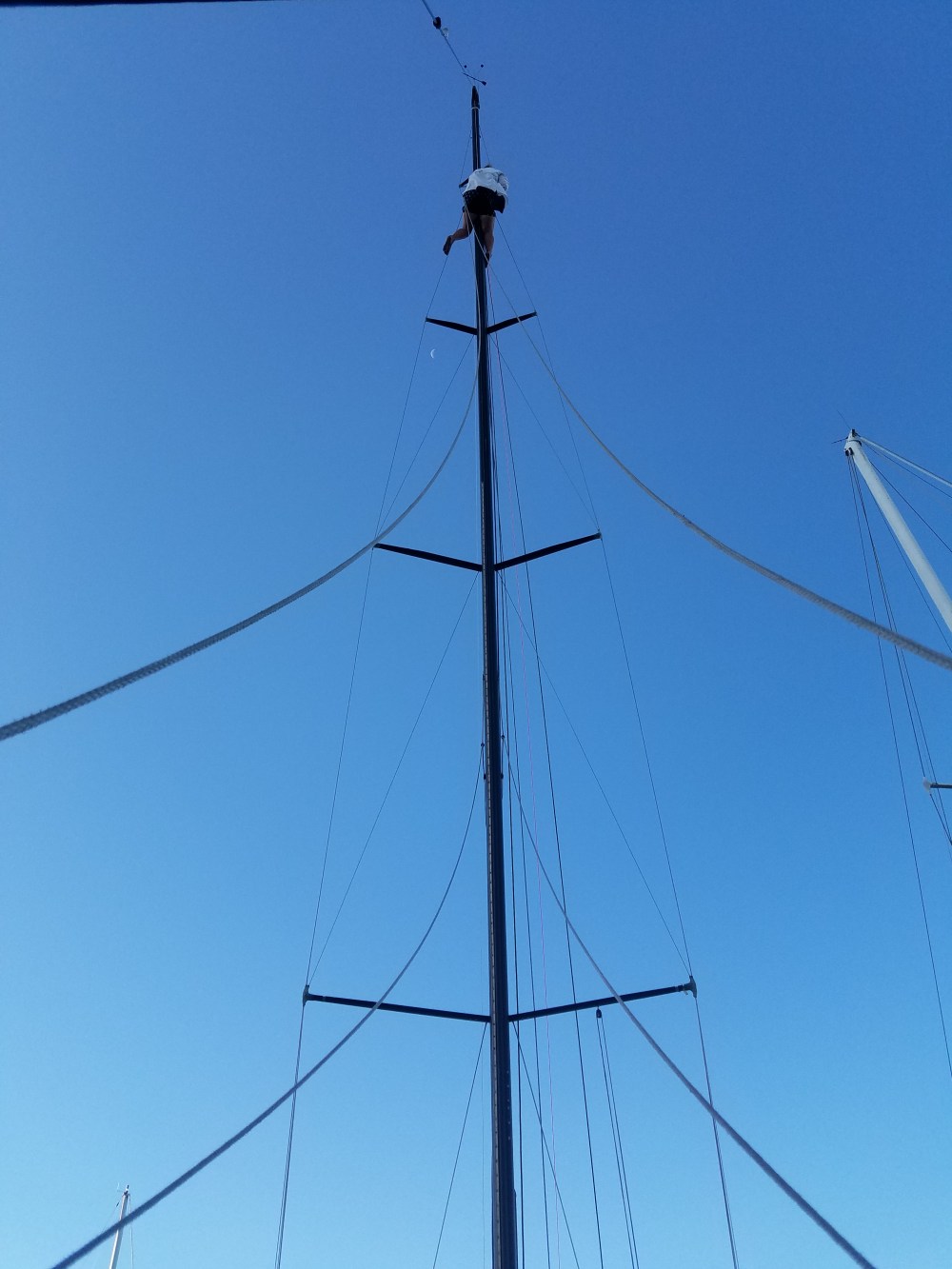
The pennant for the radar detector chaffed though, so the radar detector fell to the deck. To fix it, one of us had to go up the mast. Megan volunteered. She went up in the Spinlock harness early in the morning, while conditons were calm. After installing a new block, she went up the mast and did a visual inspection. She found no issues.

The Yanmatr diesel engine was ready for a tune-up at 480 hours. I finally found a Yanmar authorized representative and bought multiples of the critical parts, like filters for fuel, oil and air, the impeller, water pump belt and oil.

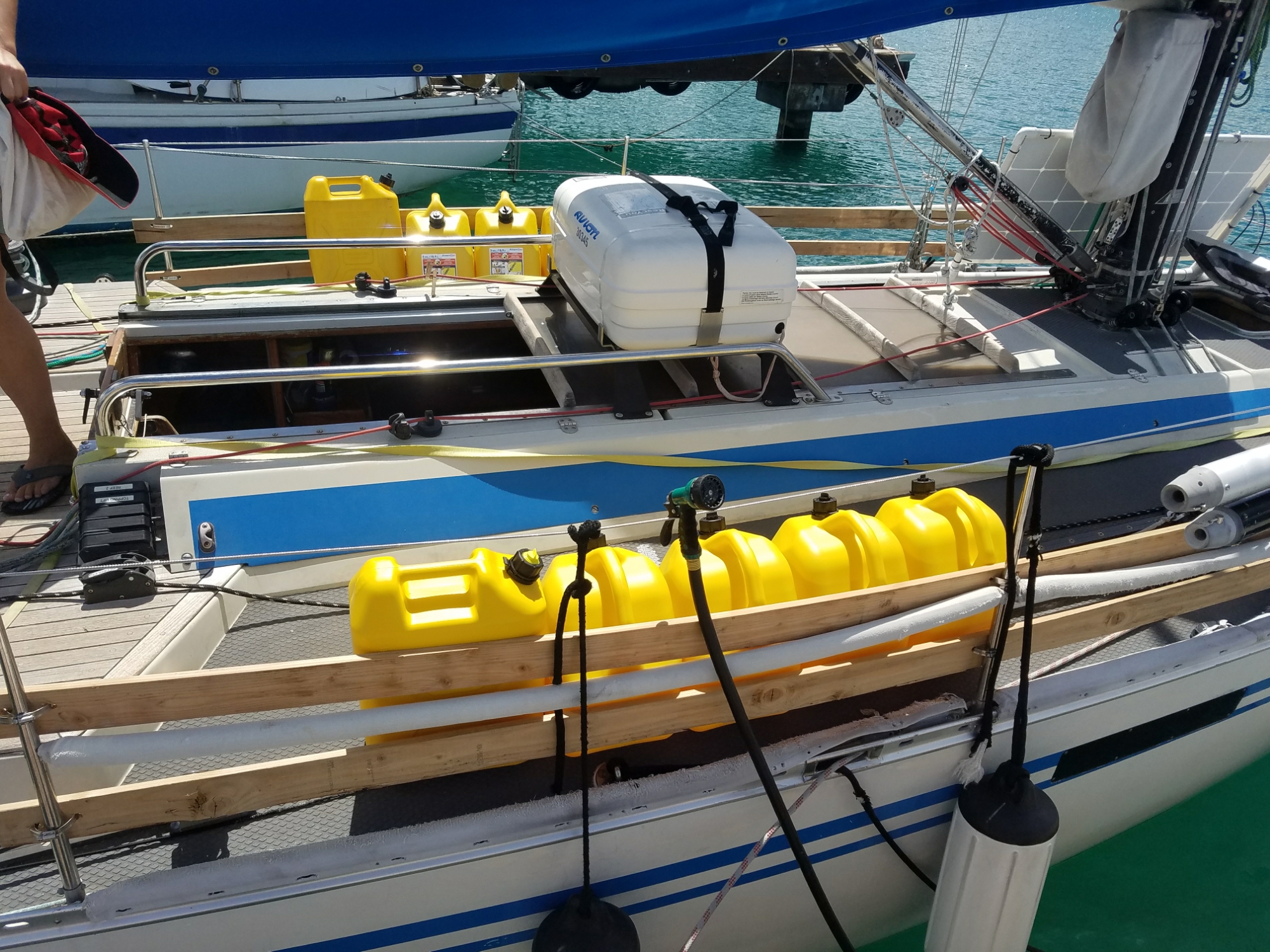
A big part of planning this trip is the decision about how much fuel carry. One must be prepared to motor through light winds, if they cannot be avoided. The rule of thumb is to carry 100 gallons on the return trip, but my plan is to carry a total of 90 gallons. I figure this is enough to motor for about 1,000 miles. Avion’s fuel tank only holds 20 gallons, so I carry 6 jerry cans in the aft lazarette, for a total of 50 gallons. I have purchased an additional 8 jerry cans, to add another 40 gallons. I installed 1×4 stapping that connects 3 stantions, on both port and starboard, and will stack the jerry cans on the high-side rail for ballast.
This past week we have been organizing the boat, and provisioning. The trip should take between 16 to 18 days, so we need a fair amount of food and water for 3 people. We also need to have plenty of space available. To lighten the load and open-up space in the sail locker, I will ship back the sails we we are not using, and anything that we have gathered during our stay that is not necessary for the return trip. DHX Hawaii will ship a 4x3x6 foot palette for $479, and it will be in Oakland by the time we return.

Since the weather this year is unpredictable, I have contracted with a professional weather router, Rick Shema. His web site is TheWeatherGuy.com. He will help us in many ways, including a preferred departure date, provide a route for the first 5 to 7 days, monitor our progress, and provide updated route suggestions every every three days, or as needed. This significantly reduces the largest single risk we face, of sailing into a storm, with heavy wind and waves. There is currently a cut-off low floating around that requires special attention.
In terms of communications while on the ocean, I have an Iridium satellite phone on board that can make phone calls, text and send emails though Sailmail (WDG346 AT sailmail DOT com). I will also use a SPOT tracking device to give people a way of monitoring our progress. I will put the SPOT tracker URL in a sepatate post.
We are at a point where we are down to the last few major tasks, like cleaning the bottom, getting diesel, refilling the propane tank, and a last stop at Wedt Marine for odds and ends. On Tuesday, we hooe to take our good friends Hal and Laurie out for lunch, as they loaned us their car for 5 weeks. We expect to leave Kewalo Harbor on Wednesday, and sail to Lahina to meet Jimmy, and then work with Rick to determine when to leave. I expect to make one more posting before we leave. Once underway, I will make an occasional update to the blog using email (no pictures). So, stay tuned…


 avionbianca
Tom, thanks for all the details. Sometime I want to find out how you replaced the through hull ball valve while in the water! I just launched our Marshall 22 CATZILLA for the summer season here. My own challenges are small compared to yours. It’s humbling and eases whatever anxiety I feel about my boat maintenance.
Fair winds and thanks for the email and tracking link.
Spencer